
To help minimise the likelihood of injuries, it is critical our horse is fit for the level and type of work they will be doing. Whether you are increasing their fitness so you can compete, returning to work after any kind of break or increasing their exercise load to reduce their weight. This fitenning process should be worked on gradually, over a period of weeks to enable the horse’s body to adjust to the changes in exercise level. Sudden increases or dramatic changes in exercise load can result in pulled or torn muscles, jarred joints or poor performance. Your training should also be reflective of your goals; for example, if you plan on joining a 12-mile fun ride, you need to get out of the arena and hack so your mount gets used to variable terrain rather than the controlled arena surface.
Following a break, your training programme will require adjustment to account for the time off. However, the degree of change will be variable. If your horse has a week or ten days off while you are on holiday, they will require a two-week ‘retune’ before returning to unaffiliated competition. In comparison, a winter of occasional light hacks would require nine to ten weeks of careful fitness work before being ready to compete.
If you are starting your fitness journey ‘from scratch’ make sure your horse is ready to start work by checking they are up to date with any vaccinations, dentistry, physiotherapy, and shoeing. Obviously, if you are returning to work after a break or reduction in workload, you still need to ensure your horse is healthy. The regular attendance of equine professionals such as your farrier or veterinary physiotherapist can be useful; remember, people who see your horse regularly, but not daily, will notice changes you might miss. This could be useful by helping with the early detection of issues which may require veterinary assistance.
While a plan similar to the one outlined below is suitable for most riders, we must remember each horse is individual, and the period of time required to get a horse fit will be influenced by the following:
● Age — Veteran horses and very young horses will take longer to get fit than those in their prime
● Starting Point — A horse which has been kept ticking over will be fitter than one which has had a field holiday with no exercise
● Previous Fitness — A horse which is used to being let down over the winter and brought back up in the spring, for example, will be fitter quicker than a horse being got fit for the first time
● Any Injuries — A horse returning to work following an injury will need specific care during the early weeks of work. Please speak to your vet or physiotherapist for their advice
The majority of fitness programmes can be broken down into three stages; the length of each stage is dependent on all the factors we have already mentioned. By completing all these stages, your horse (and rider) will be fit enough to compete and enjoy a variety of disciplines.
● Stage One – slow work to prepare the horse’s muscles, tendons and ligaments
● Stage Two – work to improve strength, stamina and basic fitness
● Stage Three – faster work to prepare the horse for cross-country-type events
No matter why your horse’s fitness has been reduced, the key to improvement is always to take it steady. Make a realistic plan and no matter how tempting, don’t push for rapid improvements. Just like us, our horses’ are keen to get out and about but do not confuse eagerness for fitness! Eagerness will get the adrenaline pumping, which may make your horse appear fitter than they are and may lead to injury. Be sure to assess the level of work your horse is in, don’t beat yourself up if they have had to take a backseat for a while, and develop their individual programme accordingly.
The horse fitness programme set out below caters to a horse which has been kept ‘ticking over’ with work including light hacks or schooling three to four days a week and whose rider intends to compete regularly in riding club level competitions. Depending on the rider’s work and other commitments, the horse should have one or two days off per week.
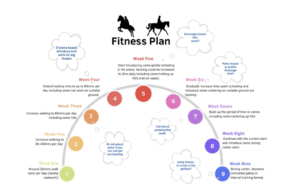
Once your horse has reached optimum fitness, it is important to consider maintaining it. Obviously, you need to ensure you continue with regular aerobic exercise, but there are also a number of other factors worth considering which may reduce the incidence of setbacks and injuries. As fitness develops, the horse’s breathing and heart rate are lower during exercise and both rates should recover faster when you stop exercising. If you notice this is not the case, you may need to spend more time on the earlier phases of your fitness plan. Slow work now lays the foundations for faster work later and will minimise the risk of injury.
Understand what is normal for your horse; they are all individual, and noticing subtle changes in their behaviour may be an indication of pain or a sign that they are not coping in some way. The ground type and condition you are riding on will also impact your horse’s well-being, and they need time to acclimatise. For example, if you are aiming to attend horse trials with your dressage and show jumping phases on grass, it is important to practise on grass a number of times before you compete. However, if the ground is hard and your horse is in the later weeks of their fitness programme, you can consider training at a local gallops or taking them swimming as a substitute to fast canter work. Remember, the majority of events will manage and maintain the ground to prepare a better surface than we can find out hacking.
While our focus may easily be on ensuring our horse receives enough work, it is essential we pay attention to properly warming up and cooling down. This will help keep your horse’s muscle tone elastic, and reduce the risk of injuries to tendons and ligaments. It can also help to prevent colic or painful muscle cramps.
Warming up raises your horse’s heart rate, increases the oxygen flow to their muscles, and gets them thinking about the job they are about to do. The rules for warming up can’t be rigid, but we need to consider the horse’s temperament along with the weather and ground conditions. Riding a horse from the stable or the lorry will require a longer warm-up than a horse being ridden from the field.
Cooling down reduces the heart rate, drawing lactic acid away from the muscles and reducing the risk of inflammation. Always be careful to bring the horse back down through the paces and then walk until their respiration rate has fully recovered. The time spent cooling down is also important as it allows you and your horse to process the work you have done and mentally wind down. The video link below demonstrates a horse ‘blowing’ after exercise…keep walking until this stops!
Following every ride we should wash or brush off any sweat marks, check that the bit and tack have not rubbed the horse in any way, pick out feet, and if wearing them, check the horse’s shoes are still secure. After a cross-country run or if the ground you have ridden on was particularly hard, deep or wet, carefully check the legs for heat and swelling. After strenuous exercise or working on these kinds of ground conditions, the use of ice boots, cold-hosing, or, where possible, a cold water spa can be very helpful in the recovery of your horse’s lower leg and can help minimise the slight inflammation that naturally occurs following hard work.
Ensuring you pay attention to achieving and maintaining your horse’s fitness will minimise the likelihood of injury and maximise your horse’s performance throughout your competition season. Please remember vets, physiotherapists, and other professionals are always available to advise on improving horse fitness.
This post has been written by Robyn Hutchinson, owner of RA Therapy and Training, based just outside of Shipston on Stour. Robyn has a passion for helping both horse and rider to help minimise injury and maximise performance. Veterinary physiotherapy and coaching services can be provided at your own yard or from the RA Therapy and Training Centre, where they provide treatments using the ECB Cold Saltwater Spa and Equine Theraplate, along with individually tailored options for residential rehabilitation livery.
Follow the link below to find out more about Robyn, the RA Therapy team and available facilities.
If you’d like any advice from your vet, please contact the team.


